Things Stoke-on-Trent People Will Defend Until Death
- Chris Beckett

- May 27
- 8 min read
A Southerner’s Survival Guide After 28 Years Living In Staffordshire
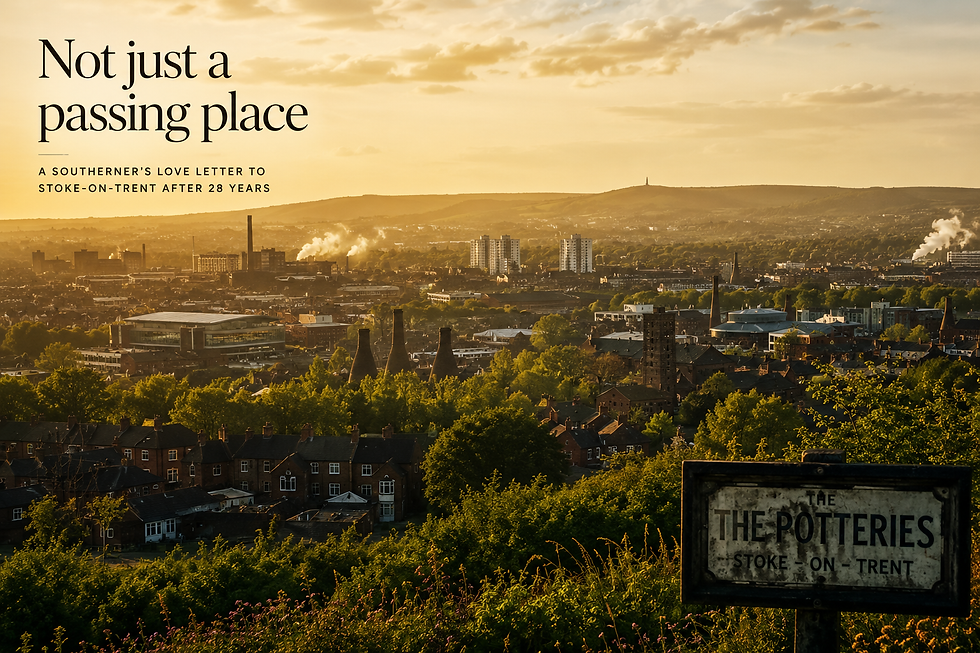
I moved to Staffordshire from Bournemouth in the late nineties, convinced — with the quiet confidence only young people possess — that it probably wouldn’t be forever.
A few years perhaps. Long enough to work, settle briefly, experience another part of the country and eventually drift back south towards the sea.
Instead, something unexpected happened.
Life settled around me before I fully realised it was happening.
Work became routine. Friendships formed quietly. Familiar roads stopped feeling unfamiliar. The accents softened around the edges of my hearing until one day I realised I no longer needed mental subtitles in oatcake shops.
Then came the deeper roots. Family. Children. NHS shifts. Long winters. Summers spent driving west towards North Wales with half of Staffordshire apparently making the exact same journey at the exact same time.
And somewhere along the line, Staffordshire stopped feeling like the place I had moved to.
It became home.
That probably sounds sentimental, but places rarely become home through grand moments. More often, it happens gradually through repetition. Through ordinary Saturdays. Through seeing the same people in the same cafés. Through school runs and canal walks and rainy pub lunches. Through tiny unnoticed rituals that slowly stitch themselves into your life.
The strange thing about Stoke-on-Trent is that outsiders often misunderstand it.
The clichés tend to arrive first. Pottery. Industry. Grey skies. Football. Roundabouts.
But live here long enough and you begin to notice something else entirely.
You notice the humour. The resilience. The warmth hidden beneath the directness. The way people still talk to each other here. The way communities somehow continue existing despite modern life trying its absolute hardest to erase them.
You also notice that Stoke people will defend certain things with astonishing levels of passion.
Not political things necessarily.
Oatcakes.Lobby.The correct route to Wales.Whether Hanley is “still decent actually.”The fact that eleven degrees apparently counts as barbecue weather.
And honestly?
After twenty-eight years here, I sort of understand why.
Stoke-On-Trent : More Than Just Six Towns

Before you can really understand Stoke-on-Trent, you have to understand that it is not a city in the neat, simple way outsiders often imagine a city.
It is a federation. A collection. A slightly complicated family argument with civic status.
The modern city was formed from six towns: Tunstall, Burslem, Hanley, Stoke, Fenton and Longton. Locals will know that Burslem is often called the Mother Town, which sounds beautifully ceremonial until you realise people can still argue about town identity with the emotional intensity of a family Christmas dispute.
Each town has its own character. Its own loyalties. Its own memories. Its own version of what Stoke “really” is.
That is part of the magic and part of the confusion.
From the outside, people often see one place. From within, it is much more layered than that.
Burslem carries the weight of pottery history. Hanley became the commercial centre. Stoke gave the city its name. Longton, Tunstall and Fenton all bring their own industrial, working-class and cultural histories to the mix. And yes, Fenton still knows Arnold Bennett left it out when he wrote about the Five Towns. Some wounds never fully heal.
This is the Potteries: the world capital of ceramics, a place where clay, fire, skill and graft shaped not just local identity but global taste. Josiah Wedgwood was not merely a local businessman with a famous surname. He was one of the great figures of the Industrial Revolution, turning craftsmanship, innovation and design into an international force.
That matters.
Because Stoke’s story is not small. It is not provincial in the dismissive way people sometimes use that word. It is a place whose work travelled the world.
And then there are the people.
Captain Edward John Smith, the captain of the Titanic, was born in Hanley. That alone would be enough for most cities to dine out on for generations. Titanic Brewery in Burslem nods to that connection, and while this may not be the most academically rigorous sentence in the piece, I can personally confirm that their Plum Porter is absolutely worth your attention.
Then there is Reginald Joseph Mitchell, born locally and forever linked with one of the most important aircraft in British history: the Supermarine Spitfire. Mitchell’s story feels almost too large for the city to hold quietly, yet Stoke does hold it quietly — with the understated pride it gives to many of its own.
Sport has its own legends here too.
Sir Stanley Matthews, the Wizard of the Dribble, remains one of English football’s great names. Gordon Banks, forever associated with one of the most famous saves in World Cup history, became part of Stoke’s sporting identity through his years at Stoke City. Phil Taylor turned darts into domination. Eddie Hall made lifting half the planet look like a reasonable Tuesday. Robbie Williams carried a version of Stoke humour, swagger and vulnerability onto the world stage.
There are business names too. Peter Coates and bet365. John Caudwell and Phones 4u. Local success stories that reshaped industries far beyond Staffordshire.
And then there is Arnold Bennett, whose writing gave the Potteries a literary identity that still lingers, even if he did commit the unforgivable local offence of making everyone say “Five Towns” and quietly misplacing Fenton like a set of car keys.
What I have learned, living here as an outsider who accidentally became local by duration, is that Stoke-on-Trent carries its history differently from some places.
It does not always package itself neatly. It does not always shout loudly enough. It does not always realise how interesting it is.
But beneath the jokes about oatcakes, roadworks, Hanley, and whether it is ever acceptable to go through Festival Park at half five, there is a city with remarkable depth.
A city of makers, grafters, performers, engineers, sportspeople, artists, nurses, factory workers, founders and families.
A city that has sent pottery to dining rooms, footballers to legend, aircraft into history and pop stars into stadiums.
Not bad for somewhere outsiders still occasionally describe as “near Alton Towers.”
The Oatcake Situation

The first time somebody handed me what looked like a floppy savoury pancake stuffed with bacon, cheese and brown sauce and then acted like it was sacred cultural heritage, I was genuinely confused.
I smiled politely.Internally, I judged everybody.
Because as a southerner, I simply wasn’t prepared for the seriousness of oatcake culture.
This is not casual breakfast territory.This is identity.
Every Stokie seems to carry a deeply personal loyalty towards a particular oatcake shop, usually spoken about with the seriousness of inherited family tradition.
Mention the wrong one and conversations can turn surprisingly tense.
What I eventually realised is that oatcakes are not really about food at all.
They’re about familiarity. Comfort. Routine. The kind of small regional rituals that quietly anchor people to a place.
Twenty-eight years later?
I would now defend oatcakes in armed combat.
There’s something deeply comforting about them. Especially on cold mornings, after long NHS shifts, rainy Sundays or any life event requiring carbohydrates and emotional support.
And perhaps that’s part of the wider charm of Staffordshire generally.
It’s unpretentious.Nobody’s trying too hard.Comfort still matters here.
People Here Actually Talk To Each Other
One of the first things I noticed after moving north was that conversations happened far more easily here.
Not performative conversations. Not polite southern small talk where everybody apologises constantly while revealing absolutely nothing about themselves.
Real conversations.
In Bournemouth, neighbours could live beside one another for years and communicate entirely through carefully managed nods and passive-aggressive bin positioning.
In Stoke, somebody you met once in Aldi may well ask after your family six months later.
People here have a warmth that can initially catch southerners off guard. There’s less social choreography. Less polishing around the edges.
And yes, there is also the word “duck.”
I resisted it for years.
Now it appears in my vocabulary with alarming regularity.
The transformation feels complete.
But underneath the humour there’s something genuinely reassuring about the openness here. Especially after years working in healthcare across Staffordshire.
You begin to understand how much communities still matter when people continue behaving like communities.
Stoke People Secretly Love A Queue

Nobody complains about queues more dramatically than Staffordshire people.
And yet somehow everybody still joins them immediately.
Farm shops.Car boots.Oatcake shops.Talacre Beach traffic.Trentham at Christmas.Alton Towers on a sunny Saturday.
The complaining begins almost instantly.But nobody leaves.
There’s almost a strange sense of community within British queue culture.
A collective understanding that yes, this is mildly irritating… but we’re all suffering together.
Very British.
The Weather Is Apparently “Not Cold”

I arrived from the South believing weather forecasts mattered.
Staffordshire quickly corrected this misunderstanding.
Here, if there’s technically no snow physically landing on your forehead, somebody will confidently announce:
“It’s not cold duck.”
Meanwhile:
men are wearing shorts in February,
beer gardens remain operational at eleven degrees,
and barbecue discussions begin the second sunlight appears for longer than nine consecutive minutes.
Honestly?
I respect the resilience.
There’s a toughness to people here. A practical realism.
Life carries on.The weather is simply background noise.
Everybody Eventually Ends Up In Wales

At some point, every Staffordshire family develops a deep emotional attachment to North Wales.
Talacre.Rhyl.Llandudno.Abersoch if somebody’s had a decent tax return that year.
Entire childhoods here seem built around:
packed cars,
cool boxes,
beach windbreakers,
slightly damp chips,
and heroic levels of beige buffet food.
And honestly?
I completely understand it now.
There’s something brilliantly therapeutic about escaping to the coast for the day when life gets noisy.
Maybe that’s the Bournemouth side of me talking.
I still head back home regularly for my sea-air reset. There’s probably saltwater embedded somewhere in my DNA at this point.
But Staffordshire families understand something important:
you don’t always need luxury.
Sometimes you just need sea air, chips and everybody laughing together in hoodies because the “heatwave” lasted fourteen minutes.
Staffordshire’s Quiet Beauty

Nobody warned me how beautiful parts of Staffordshire actually are.
Before moving here, if somebody had described:
canals,
forests,
rolling countryside,
hidden lakes,
Peak District access,
huge sunsets,
and endless walking routes…
…I probably wouldn’t have guessed Stoke-on-Trent.
But places like:
Downs Banks,
Cannock Chase,
Mow Cop,
Rudyard Lake,
the canal walks between Stone and Barlaston,
and the Peaks just beyond…
completely changed how I see this area.
Staffordshire has a quieter beauty to it.
It doesn’t scream for attention the way some places do.
It just slowly gets under your skin over time.
A bit like the people.
The Brutal Honesty Is Weirdly Refreshing
[IMAGE PLACEHOLDER: Friendly local pub conversation scene with warm lighting, relaxed atmosphere and authentic Staffordshire character.]
Southerners are masters of indirect communication.
We’ll say:“We should definitely arrange something sometime.”
Meaning:“Absolutely never.”
Meanwhile Stoke people will simply tell you:
“Nah duck that’s rubbish.”
And honestly?
It’s refreshing.
People here generally say what they mean.There’s less performance.Less pretending.
After a while, you realise how exhausting constant politeness theatre can actually be.
Staffordshire people are warm, funny, grounded and remarkably good at finding humour in difficult situations.
There’s resilience here.A realism.But also an enormous amount of heart underneath it all.
So Why Did I Stay?

That’s probably the real question.
Because yes — I still go back to Bournemouth regularly.I still need the sea sometimes.Still miss coastal air.Still think chips somehow taste different by the beach.
But somewhere over these last twenty-eight years, Staffordshire stopped being “the place I moved to.”
It became home.
It’s where Becky and I built our blended family.Where we built careers.Where we worked exhausting NHS shifts.Where we built friendships.Where we eventually built No.1 Urban Aesthetics
And perhaps most importantly, it’s where we built a life.
Despite the jokes — and there are many — there’s something genuinely special about this part of the world and the people in it.
Even if I still occasionally need subtitles in oatcake shops.
Final Thought
If you’re from Stoke-on-Trent, you’ll probably defend this city forever.
And if you moved here from somewhere else like I did?
Give it enough time.
One day you’ll find yourself:
passionately arguing about oatcakes,
recommending canal walks,
queueing voluntarily for lobby,
and casually calling strangers “duck.”
At which point there’s really no going back.
And honestly?
You probably won’t want to.
About No.1 Urban Aesthetics
At No.1 Urban Aesthetics, Becky and Chris combine decades of NHS experience with a quieter, more grounded approach to aesthetics, skincare and wellbeing.
Based in Newcastle-under-Lyme, the clinic focuses on healthy skin, subtle results and helping people feel comfortable in their own skin — without the pressure, trends or unrealistic expectations that increasingly dominate online culture.

📍 Newcastle-under-Lyme, Staffordshire
📞 01782 444086
✨ Healthy skin. Quiet confidence. Still completely you.
