THE LIP ISSUE
- Becky Beckett

- Jun 30
- 26 min read
Dermal Lip Fillers, Modern Beauty and the New Meaning of a Beautiful Mouth
By Rebecca Beckett, Registered Nurse and Co-Director of No.1 Urban Aesthetics
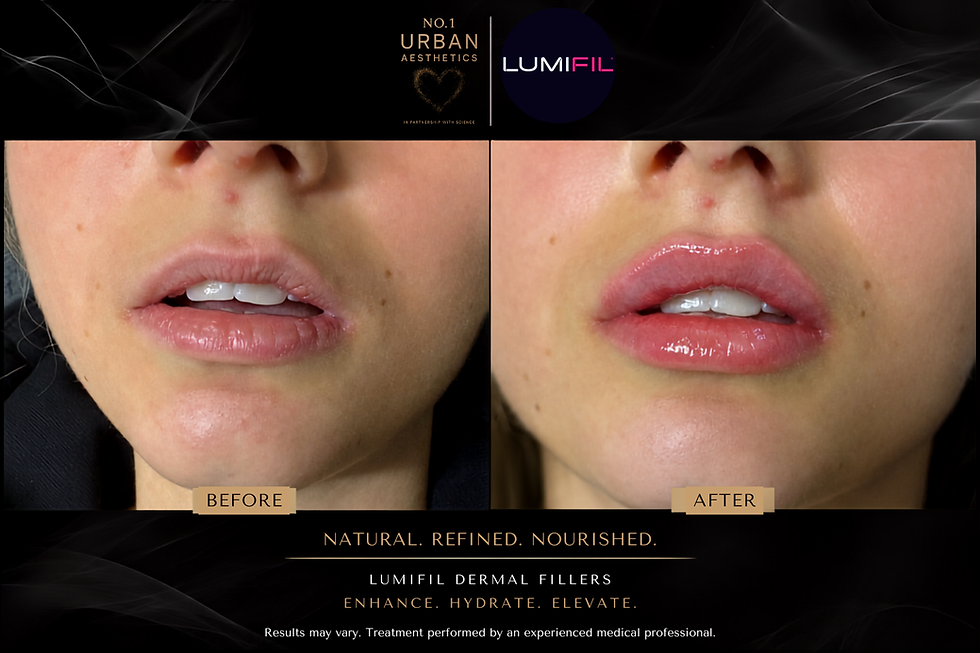
There was a period when lip filler announced itself before its owner had entered the room.
The outline was emphatic. The projection was deliberate. The volume was the point. You were not meant to wonder whether someone had undergone treatment; you were meant to know.
Beauty has since moved on.
The most desirable lips today do not look manufactured, copied or inflated. They look considered. They suit the face above them, the chin below them and the person living behind them. They move properly when that person smiles. They retain their character. They still look believable without lipstick, flattering lighting or a carefully selected camera angle.
Modern lip filler is no longer simply about making lips larger.
It can be about restoring definition that has softened with age. Correcting an imbalance that has always bothered someone. Supporting a lip that disappears when smiling. Improving proportion between the upper and lower lip. Softening fine lines around the mouth. Rebuilding structure following gradual volume loss. Or adding just enough fullness to make the face look fresher without changing its identity.
Sometimes the most successful treatment is barely detectable.
That may sound like an unusual statement from someone who performs aesthetic treatments, but it is central to how I believe good aesthetics should work. The objective is not to make every client look treated. It is to help each client look balanced, confident and recognisably themselves.
At No.1 Urban Aesthetics in Newcastle-under-Lyme, our approach to lip enhancement is clinical, conservative and individual. We do not work from a standard lip template, because faces are not standard. We do not promise that every client needs one millilitre, because syringes are units of product, not beauty targets. We do not regard bigger as automatically better, nor do we pretend that every result should be so subtle that treatment becomes pointless.
There is room between “nothing” and “too much”.
That is where thoughtful lip filler belongs.

Lip Filler Has Grown Up
Lip enhancement sits in an unusual position within beauty culture.
It is one of the most recognised non-surgical aesthetic treatments, but it is also one of the most misunderstood. It has been glamourised, criticised, copied, mocked and filtered almost beyond recognition.
Social media helped to make lip filler mainstream, but it also created a strange visual distortion. We became accustomed to seeing lips photographed at very close range, often immediately after treatment, under ring lights, with swelling still present and the surrounding face cropped away.
A pair of lips could receive thousands of compliments despite nobody seeing how they related to the nose, cheeks, jaw or chin.
But lips do not exist independently of the face.
A beautiful result cannot be judged from an isolated photograph alone. It must be assessed as part of the facial profile, at rest, during speech and when smiling. The width of the mouth, dental support, chin projection, philtral length, nose shape and natural asymmetry all influence what will look appropriate.
This is why the same lip shape cannot simply be transferred from one person to another.
A treatment that looks elegant on a face with strong cheek and chin structure may look overpowering on a smaller or more delicate face. A pronounced cupid’s bow may beautifully suit one client but look artificial on someone whose natural anatomy is softer. A strongly projected upper lip can disturb the profile even when the lips appear attractive from the front.
The camera can forgive things the face cannot.
Good treatment therefore begins before a needle is opened. It begins with observation.
What Is Dermal Lip Filler?
Most modern temporary lip fillers are made using hyaluronic acid, commonly shortened to HA.
Hyaluronic acid is a substance naturally present within the body, including the skin and connective tissues. In dermal filler products, it is formulated into an injectable gel designed to provide hydration, structure or volume depending on the properties of the particular product.
Not all fillers are identical.
Some gels are softer and more flexible. Others provide greater structure or projection. Products can vary in cohesivity, elasticity, particle characteristics and the way they integrate into tissue. The choice of product should therefore be based on the treatment area, the client’s anatomy and the intended outcome—not merely on whichever brand happens to be fashionable online.
For lip treatment, a practitioner may use filler to:
Improve the definition of the vermilion border.
Enhance or soften the cupid’s bow.
Add central or lateral volume.
Improve the relationship between the upper and lower lip.
Support the corners of the mouth.
Correct selected asymmetries.
Restore volume that has reduced over time.
Improve the appearance of fine lines around the lips.
Increase hydration and softness.
Create subtle projection where the profile requires it.
The treatment plan may involve one of these aims or a carefully judged combination.
Dermal filler does not stop the ageing process, permanently alter muscular movement or produce exactly the same longevity in every client. It should also not be treated as casually as a beauty appointment involving no clinical risk.
The NHS advises people considering cosmetic procedures to investigate the treatment, product and practitioner carefully and to understand that even non-surgical procedures can cause complications.
That does not mean clients should be frightened. It means they should be properly informed.
Informed clients make better decisions.
The Anatomy of an Attractive Lip
There is no single perfect lip ratio.
That sentence matters because aesthetic fashion has spent years suggesting otherwise.
Beauty trends frequently reduce faces to mathematical formulas: a particular upper-to-lower-lip ratio, a prescribed degree of projection or a single ideal cupid’s bow. Ratios can be useful assessment tools, but they are not commandments.
Ethnicity, age, sex, skeletal structure, dental position and individual facial character all affect what appears harmonious. A naturally fuller upper lip may be entirely appropriate. A more generous lower lip may complement another face. Some clients have a strong cupid’s bow; others have a naturally flatter central shape.
The job is not to erase these differences.
When I assess lips, I am considering several elements at once.

The vermilion border
This is the boundary between the coloured lip and the surrounding skin. It may be naturally defined, softly blended or less distinct following age-related change.
Enhancing this border can improve definition, but excessive treatment can create a rigid outline or an obvious shelf. Definition should not come at the expense of softness.
The cupid’s bow
The cupid’s bow is the central double curve of the upper lip. Some clients want it sharpened; others want a softer shape.
Overemphasising this feature can make a lip look stylised rather than natural. The correct approach depends on what is already there.
The philtrum and philtral columns
The philtrum is the vertical groove between the nose and upper lip, bordered by two subtle columns. Its length and shape affect how the upper lip appears.
A longer philtrum can make the upper lip look thinner or less visible. Filler may improve support in selected cases, but it cannot reproduce the effect of surgical lip lifting and should not be pushed beyond what the tissue can accommodate.
The tubercles
The lips contain natural areas of fullness, sometimes referred to as tubercles. Respecting these structures helps to maintain believable contour.
Filling the lips as one uniform sausage-shaped space removes the variations that make them look human.
The oral commissures
These are the corners of the mouth. Their position can affect whether the face appears neutral, uplifted or downturned.
Corner support may form part of a wider treatment plan, but simply placing filler into the corners without understanding the surrounding anatomy can create heaviness.
Lip show and dental show
How much of the lip and teeth are visible at rest and during smiling also matters. Some clients have an upper lip that rolls inward when they smile. Others show a larger amount of gum or tooth.
Filler may improve selected concerns, but the underlying cause must first be understood. Muscular movement, dental structure and skeletal proportions cannot always be solved by adding volume.
The profile
The side view is where poorly judged filler often reveals itself.
Excessive forward projection, particularly in the upper lip, can create a shelf-like appearance. Even when the result looks acceptable from the front, it may disturb the relationship between the nose, lips and chin.
This is why proper assessment must include more than a front-facing photograph.
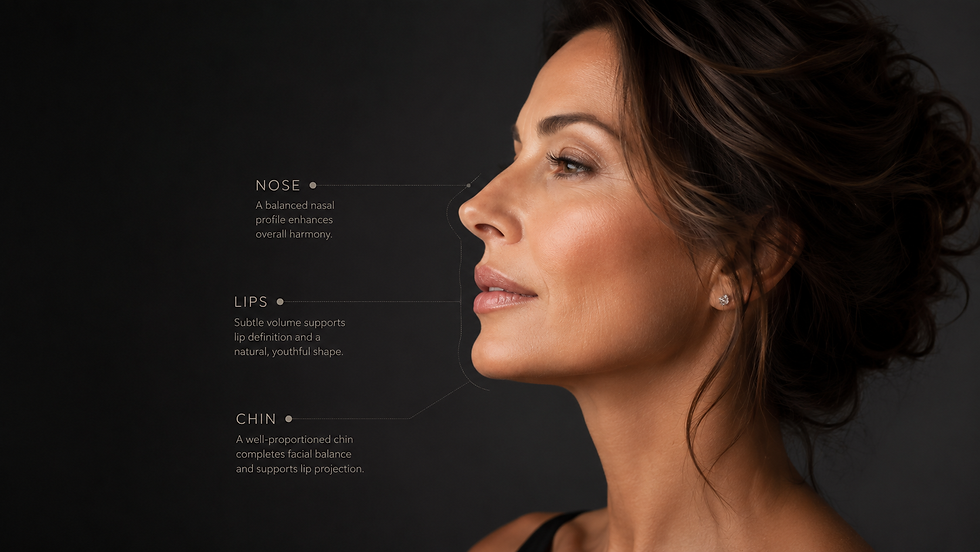
What Does “Natural Lip Filler” Actually Mean?
Natural does not necessarily mean tiny.
It means credible.
A client with naturally full facial features may comfortably carry more lip volume than someone with a fine bone structure and a narrow mouth. A treatment can be noticeable and still look beautifully balanced. Equally, half a millilitre can look unnatural when it is placed into the wrong tissue, with the wrong technique or into lips that are already overfilled.
Natural-looking filler usually shares several characteristics:
The lip remains soft in appearance.
The borders are defined without looking rigid.
The upper lip does not project excessively.
The result fits the rest of the face.
Natural variations in contour remain visible.
The lips move normally during speech and smiling.
The skin is not placed under obvious tension.
The treatment does not erase the client’s original identity.
There is also an important distinction between a natural result and a natural starting point.
Some clients arrive with untreated lips. Others have undergone several previous treatments, possibly with different products and practitioners. Existing filler may have integrated well, may have shifted beyond the intended lip border or may be contributing to heaviness and distortion.
Adding a small amount of new filler to an already compromised foundation does not automatically create a subtle result.
Sometimes the safest and most aesthetically sensible recommendation is to stop adding product.
In selected cases, a period without treatment may be appropriate. In others, dissolving existing hyaluronic-acid filler and allowing the tissue to settle may provide a better foundation for future work.
This is not failure.
It is maintenance.
Fashion editors understand the value of editing. The same principle applies to aesthetics: when every feature is emphasised, nothing feels refined.
Lip Filler Migration: What People Usually Mean
“Migration” has become one of the most frequently used words in online filler discussions.
It is often used to describe fullness, shadowing or a ridge above the natural lip border, particularly in the upper lip. However, not every irregularity is confirmed migration, and not every photograph taken immediately after treatment represents the final result.
Early swelling can temporarily blur the lip border. Product placement, previous filler, anatomy and repeated treatment can all affect appearance.
Potential contributing factors to an undesirable result may include:
Too much product for the available tissue.
Repeated treatment before previous filler has sufficiently settled.
Product positioned outside the intended anatomical plane.
Inappropriate product selection.
Pressure within overfilled tissue.
An attempt to create projection that the anatomy cannot support.
Adding filler to camouflage an existing problem.
Failure to reassess the face between appointments.
The answer is not always to dissolve everything immediately, nor is it always to add more.
It is to assess properly.
Dissolving hyaluronic-acid filler is a clinical procedure involving an enzyme called hyaluronidase. It carries its own risks and should not be presented as a casual eraser or an automatic reset button.
The existence of a reversal option must never be used to justify careless treatment.
Our aim should be to make good decisions before product is placed.
Half a Millilitre Versus One Millilitre
Clients frequently ask whether they need 0.5ml or 1ml of lip filler.
The honest answer is that the number alone does not tell us enough.
Half a millilitre is a relatively small amount of product, but its effect depends on where it is placed. It may provide delicate definition, hydration or correction in suitable lips. It may also be insufficient for a client seeking structural change.
One millilitre offers more scope to distribute product across different areas, but it should not automatically be used simply because a full syringe has been purchased or opened.
The decision should consider:
Existing lip volume.
Tissue quality.
Previous filler.
Lip width.
The degree of asymmetry.
The desired result.
The client’s tolerance for visible change.
Whether this is a first treatment.
How the lips relate to the wider face.
What can safely and responsibly be achieved in one session.
A careful practitioner may recommend staged treatment rather than attempting to reach the final result in a single appointment.
Staging allows the tissue to settle and gives both client and practitioner an opportunity to reassess.
It may be less dramatic on reveal day, but better aesthetics is not a competitive sport.
At the time of publication, our listed prices include 0.5ml lip filler from £90 and 1ml lip filler from £160. Prices and suitability should always be confirmed through the current treatment and pricing information before booking.
Internal link: View dermal filler treatments in Newcastle-under-Lyme
Internal link: View current treatment prices
First-Time Lip Filler: What I Want Clients to Know
Most first-time clients are not afraid of looking better.
They are afraid of no longer looking like themselves.
They may have saved screenshots of lips they like while simultaneously insisting they do not want to look “done”. They may have delayed booking for months because they have seen a poor result on somebody else. They may have been told by friends that one millilitre is nothing, or that they should immediately book a second session.
Online advice can be loud. Your anatomy is quieter.
A first consultation should create enough space for honesty.
I want to know what the client has noticed, what they hope will change and what they absolutely do not want. I also want to understand whether the request has appeared suddenly, whether it is linked to an event or emotional difficulty and whether their expectations can realistically be met.
The NHS advises against rushing into cosmetic procedures and encourages people to consider why they want treatment, what they expect it to change and how they might feel if the result does not match their expectations.
A good consultation may include discussion of:
Medical history.
Current medication.
Allergies.
Previous aesthetic treatments.
Previous reactions or complications.
Cold sores.
Pregnancy or breastfeeding.
Dental treatment.
Upcoming events or travel.
Desired shape and degree of change.
Risks, aftercare and emergency contact arrangements.
Alternatives, including choosing not to proceed.
There are occasions when treatment should be postponed or declined.
That might disappoint someone in the moment, but clinical judgement is not customer obstruction. Aesthetic medicine is still healthcare-led practice, even when the treatment is elective.
A client is not buying a guaranteed pair of lips from a catalogue.
They are consenting to a clinical procedure with expected effects, limitations and recognised risks.

What Happens During a Lip Filler Appointment?
The exact appointment will vary according to the practitioner, product and individual treatment plan, but it should not feel rushed or improvised.
At No.1 Urban Aesthetics, assessment comes first.
The lips and wider face are reviewed at rest and in movement. Existing asymmetry is discussed because all human faces have some degree of asymmetry, and filler cannot guarantee perfect symmetry.
Clinical photographs may be taken with consent. The planned treatment is then explained, including what can reasonably be achieved during that session.
The skin is cleansed carefully. Depending on the treatment plan and product, topical numbing cream may be used, and some fillers contain local anaesthetic within the product.
Filler can be placed using a needle, cannula or a combination of approaches. Different techniques have different purposes; no single branded or social-media technique is automatically superior.
The practitioner may pause repeatedly to assess balance.
The appointment is not simply a sequence of injections. It is a continuous process of observing tissue response, shape and proportion.
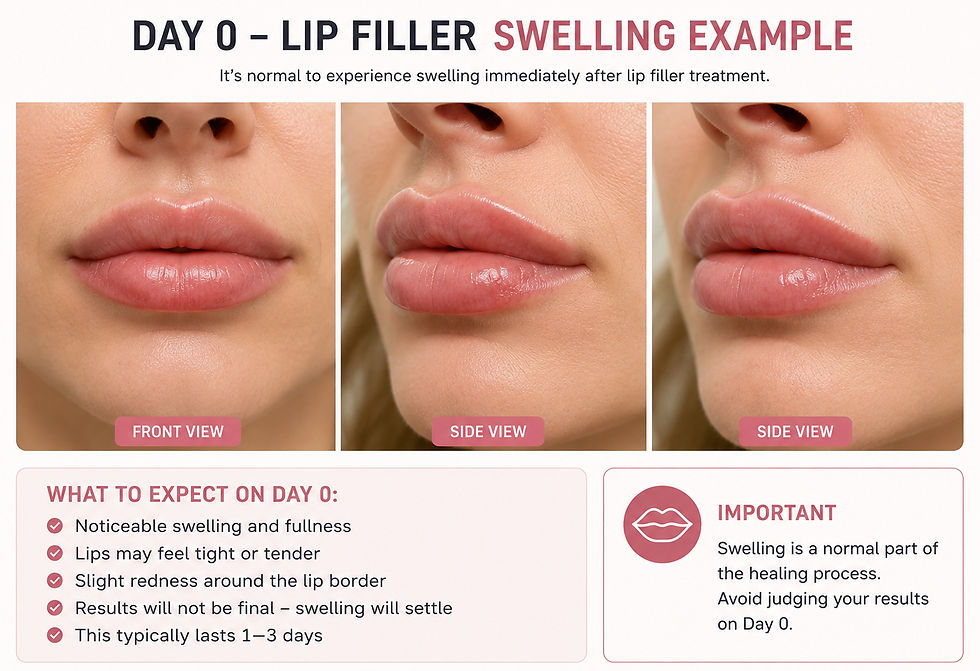
Following treatment, the lips may appear fuller than the eventual result because swelling is common. There may also be tenderness, redness, small injection marks or bruising.
This is why the mirror held up immediately after treatment does not show the finished lips.
It shows freshly treated lips.
Does Lip Filler Hurt?
No responsible practitioner should promise a completely pain-free injectable procedure.

The lips are sensitive and individual pain responses vary. Most clients describe brief sharp sensations, pressure, stinging or discomfort rather than continuous severe pain.
Comfort is improved through:
Topical anaesthetic where appropriate.
Products containing local anaesthetic.
Controlled injection technique.
Allowing sufficient appointment time.
Supporting anxious clients rather than rushing them.
Clear communication throughout the procedure.
Anxiety can amplify discomfort. Knowing what is happening often makes the experience easier.
Clients should never feel embarrassed for being nervous. Looking away, pausing, breathing slowly or asking for an explanation does not make someone difficult.
A calm appointment is not a luxury. It is part of good care.
Swelling, Bruising and the Unfiltered Recovery Period
Social media has created the impression that treatment ends with a perfect photograph and immediate application of lip gloss.
Real life is less edited.
Swelling is expected after lip filler and may be more noticeable the following morning. One side may temporarily swell more than the other. Small lumps, firmness or unevenness can occur while the product and tissue settle.
Bruising varies considerably. Some clients experience almost none; others may develop obvious bruising despite careful technique.
This does not automatically mean something has gone wrong.
However, clients should be given clear guidance on what is expected and what requires urgent review.
General aftercare commonly includes keeping the area clean, avoiding unnecessary touching and treating swelling cautiously with a clean, wrapped cool compress rather than placing ice directly onto the skin. NHS aftercare information for injectable facial treatment also notes that tenderness, swelling and bruising can occur and advises avoiding unnecessary contact with the treated area.
Advice should be individualised, but clients may also be advised to avoid:
Pressing or repeatedly massaging the lips unless specifically instructed.
Applying unclean products directly after treatment.
Excessive heat exposure for the advised period.
Strenuous exercise immediately after treatment.
Alcohol where it may worsen bruising.
Dental treatment around the appointment unless discussed.
Judging the result too early.
Posting an angry swelling photograph at 7am and deciding their life is over.
The final point is not official clinical terminology, but it remains sound advice.
Allow the lips to settle before deciding how you feel about them.
Risks: The Section Every Credible Lip Filler Article Should Include

Lip filler is frequently performed, but common does not mean risk-free.
Expected short-term effects can include:
Swelling.
Tenderness.
Redness.
Bruising.
Temporary firmness.
Small injection marks.
Short-term asymmetry.
Awareness of the product while it settles.
Other potential complications include:
Infection.
Reactivation of cold sores.
Persistent lumps or nodules.
Delayed inflammatory reactions.
Product visibility or palpability.
Unsatisfactory shape.
Overcorrection.
Under-correction.
Asymmetry.
Migration or unwanted product distribution.
Tissue damage.
Allergic reactions.
Vascular occlusion.
A vascular occlusion occurs when blood flow within a vessel becomes obstructed. This is uncommon but serious and requires prompt recognition and management.
Clients should receive specific advice about urgent warning signs rather than being sent home with a vague instruction to “message if worried”.
Potential warning symptoms may include escalating or disproportionate pain, unusual blanching, dusky or mottled colour change, cool skin, deteriorating tissue appearance or other symptoms identified by the treating clinician.
Rarely, filler injected into or entering a blood vessel in parts of the face can be associated with severe complications, including visual impairment. This is one reason why anatomical knowledge, emergency preparedness and appropriate complication pathways matter.
The NHS advises clients to ask what product will be used, where it came from and what qualifications, training and experience the practitioner has.
The person performing treatment should also be able to explain:
How complications are recognised.
What emergency equipment and medicines are available.
Who provides aftercare.
How they can be contacted outside ordinary clinic hours.
What happens if urgent medical assessment is required.
Whether they are appropriately insured.
Where the product was sourced.
How treatment and product details are documented.
A reassuring personality is lovely.
A functioning complication protocol is better.
Why Choosing a Healthcare-Led Clinic Matters
Dermal fillers are injectable medical devices, but the regulatory landscape surrounding non-surgical cosmetic treatment in England has historically allowed a wide range of practitioners to offer them.
The Government has confirmed plans for further regulation of non-surgical cosmetic procedures, with restrictions and licensing proposals being developed in stages. Existing legislation already makes it a criminal offence in England to inject cosmetic filler into someone under 18 or to arrange such treatment for them.
At the time this article was prepared, the wider licensing regime had not simply transformed every lip-filler provider into an equally regulated clinical service overnight.
Clients therefore still need to look beyond branding.
A beautiful Instagram page does not tell you:
Whether medical histories are assessed properly.
Whether products are obtained from legitimate suppliers.
Whether infection prevention procedures are robust.
Whether complications are recognised.
Whether the practitioner remains available after payment.
Whether treatment records are complete.
Whether the practitioner understands when not to inject.
Whether emergency plans have ever been rehearsed.
Healthcare registration does not make anyone infallible, and non-medical practitioners should not automatically be dismissed. Skill, education, experience and professional behaviour all matter.
But healthcare-led practice adds a framework of accountability, clinical assessment and professional duty that should carry meaningful weight when choosing somebody to perform an injectable procedure.
Rebecca Beckett is a Registered Nurse and former senior NHS nursing leader. No.1 Urban Aesthetics is co-directed with Chris Beckett, an Advanced Nurse Practitioner and Independent Prescriber.
That experience shapes the way we approach elective aesthetics: not by making the experience cold or intimidating, but by refusing to separate beauty from safety.
Why “One Millilitre for Everyone” Is Not a Treatment Philosophy
There is a commercial temptation within aesthetics to turn product quantities into packages.
One millilitre sounds neat. It photographs well. It fits neatly into a price list. But a syringe is not a compulsory dose.
Some clients need very little product to achieve a visible improvement. Others may require staged treatment. Some do not need more filler at all.
The correct endpoint should be determined by the tissue and facial balance—not by the amount remaining in a syringe.
Overfilling can gradually occur when each appointment is viewed in isolation.
A client may have looked balanced after the first treatment, then returned because the initial excitement faded. More product was added. Then another practitioner added definition. Then somebody else attempted to correct asymmetry. Each session may have felt modest, but the cumulative result can become heavy.
People also adapt quickly to visual change.
What initially appeared full can begin to feel normal within weeks. This perceptual adjustment may encourage repeated treatment even when further volume is not aesthetically necessary.
A trustworthy practitioner should be capable of saying:
“You do not need more today.”
That sentence may not maximise the immediate transaction, but it protects the client and the quality of the work.

Lip Filler in Your Twenties
Clients in their twenties often seek enhancement rather than restoration.
Common aims include increasing fullness, improving the cupid’s bow, balancing a naturally smaller upper lip or creating more visible shape when wearing makeup.
Younger tissue may be firm and resilient, but that does not mean it can accommodate unlimited product.
Repeated treatment over several years can change the character of the lips and surrounding area. What begins as subtle augmentation can become progressively less subtle when previous product is not accounted for.
A sensible long-term plan may involve:
Conservative initial treatment.
Adequate time between sessions.
Reviewing the entire face rather than chasing close-up photographs.
Avoiding trend-driven extremes.
Maintaining skin and lip health.
Recognising when no further volume is needed.
A client may be legally old enough for treatment at 18, but legal adulthood is not the same thing as automatic suitability.
In England, cosmetic fillers must not be provided to people under 18, even with parental permission.
At No.1 Urban Aesthetics, age is only one part of the decision. Maturity, motivation, expectations and the ability to give informed consent all matter.
Lip Filler in Your Thirties and Forties
During the thirties and forties, lip treatment may begin to shift from pure augmentation towards preservation and subtle restoration.
Changes can include:
Gradual reduction in lip volume.
Less distinct borders.
Increased dryness.
Fine vertical lines.
Reduced support around the mouth.
Changes in dental or skeletal support.
A longer-looking upper lip.
Corners of the mouth appearing less supported.
Makeup bleeding more easily into fine lines.
Hormonal change, sun exposure, smoking history, genetics and general skin quality may all influence how the mouth area ages.
Simply adding central lip volume is not always the correct solution.
Sometimes the lips themselves need support. Sometimes the surrounding skin is the main issue. Sometimes improving skin quality, treating perioral lines or addressing wider facial structure will create a more elegant result than enlarging the lips.
A good plan may therefore combine—or deliberately separate—different treatments over time.
The mouth should not become a floating island of volume within an otherwise maturing face.
Lip Filler During Perimenopause and Menopause
The conversation around lip filler changes again during perimenopause and menopause.
Declining oestrogen can influence skin hydration, collagen, elasticity and tissue quality. Many women notice that their lips feel drier, look less defined or seem to have reduced in volume. Fine lines around the mouth may become more visible, even in women who have never smoked.
This can create a disconnect.
The client may not want “bigger lips”. She may simply feel that her mouth no longer reflects how she sees herself.
Treatment at this stage often benefits from restraint and a wider skin strategy.
Possible goals might include:
Restoring a softer border.
Supporting shape without excessive projection.
Replacing selected lost volume.
Improving lip hydration.
Reducing lipstick bleed.
Combining subtle filler with professional skin treatments or home care.
Reviewing the lower face and perioral area as a whole.
Older or hormonally changing tissue should not automatically be treated using the same volume, pressure or technique chosen for a 22-year-old seeking obvious augmentation.
Ageing is not a defect to be filled.
The aim is intelligent support.
Related internal link: Read about how skin changes after forty
Lip Filler for Men
Male lip enhancement remains less frequently discussed, but the same principle applies: treatment should respect the client’s anatomy and desired degree of change.
Some male clients seek correction of asymmetry or restoration of lost volume rather than overt augmentation. Others want a fuller but still masculine result.
There is no universal “male lip”, and gendered rules should not override the individual face. However, creating a highly stylised cupid’s bow or excessive upper-lip projection may conflict with the desired outcome for some clients.
The consultation should establish what the client actually wants—not what a practitioner assumes they should want.
Can Lip Filler Correct Asymmetry?
It can improve selected asymmetries, but it cannot promise perfect symmetry.
Faces are naturally uneven. One side of the mouth may sit higher. Dental support may differ. Muscle movement may be stronger on one side. Previous injury, scarring or filler may affect the shape.
Static filler cannot always correct a difference caused primarily by dynamic muscular movement.
The first step is identifying what creates the asymmetry.
Attempting to “chase” perfect symmetry by repeatedly adding product can make the lips larger without making them meaningfully more balanced.
A realistic improvement is often a better objective than mathematical perfection.
Russian Lips, Tenting and Named Techniques
Aesthetic treatments are frequently marketed through named techniques.

Terms such as “Russian lips”, “tenting”, “doll lips” and “flat profile” may describe particular injection patterns or visual objectives. They can help clients communicate a preference, but they should not replace anatomical assessment.
A technique is a tool.
It is not an identity, a qualification or a guarantee.
A client requesting Russian-style lips may actually be asking for one of several things:
A more defined cupid’s bow.
Greater central height.
Less forward projection.
A flatter side profile.
A visibly enhanced result.
A particular social-media photograph.
Those goals need to be separated and discussed.
Techniques involving multiple injection points may also affect swelling, bruising and tissue trauma. The correct approach should be selected because it suits the client—not because it is trending or commands a higher price.
At No.1 Urban Aesthetics, Russian-style lip treatment is listed separately because it involves a specific planning and treatment approach. Suitability is assessed individually.
Internal link: View lip filler and Russian lip prices
Lip Filler and Cold Sores
People with a history of cold sores should disclose this during consultation.
Trauma to the lip area can reactivate herpes simplex virus in susceptible individuals. A practitioner may discuss precautions or advise the client to speak with an appropriate healthcare professional regarding antiviral management where indicated.
Clients should not conceal a cold-sore history because they are worried treatment will be cancelled.
The information is relevant to safe planning.
Active infection around the intended treatment area is also a reason treatment may need to be postponed.
A rescheduled appointment is considerably less inconvenient than an avoidable complication.
Lip Filler Before Weddings and Major Events
Lip filler should not be booked immediately before an important event.
Swelling, bruising, adjustment and the possibility of needing review must all be allowed for. First-time treatment should be planned particularly carefully because the client does not yet know how they typically swell or bruise.
The ideal timing depends on the treatment plan and event, but “the afternoon before” is not an adventurous beauty strategy.
It is administrative self-sabotage.
For weddings, milestone celebrations, professional photography or major travel, consultation and treatment should take place far enough in advance to allow the lips to settle and any planned refinement to be considered safely.
Last-minute pressure can encourage poor decision-making.
The face has no interest in your seating plan.
How Long Does Lip Filler Last?
There is no honest universal answer.
Lip filler is temporary, but longevity varies according to:
The product used.
The amount and placement.
Individual metabolism.
Lip movement.
Previous treatments.
Tissue characteristics.
Lifestyle and general health.
The visual threshold at which the client considers the effect to have faded.
Some visible improvement may remain beyond the point when the client feels the original fullness has reduced. Product behaviour can also vary within different areas of the lip.
Advertising an exact duration as though every client’s body follows the same calendar is misleading.
Follow-up treatment should be based on assessment rather than an automatic timetable.
The question should not only be, “Has some effect faded?”
It should also be, “Do the lips currently need more?”
Those are not always the same question.
What Happens When You Stop Having Lip Filler?
The lips do not normally collapse simply because temporary filler gradually reduces.
They continue to age according to genetics, health, sun exposure, smoking, hormones and time. A person may perceive their lips as smaller after becoming accustomed to a fuller appearance, but this does not automatically mean the treatment has damaged them.
However, repeated overfilling, complications or tissue stretching can create a more complex situation. This is another reason to avoid treating maintenance as an endless volume subscription.
Stopping is allowed.
Having a break is allowed.
Deciding that you prefer your untreated lips is allowed.
Consent is not a lifetime membership.
When I Would Say No to Lip Filler
There are times when I will advise against treatment.
Examples may include:
Active infection or inflammation.
Pregnancy or breastfeeding where treatment is not appropriate.
Relevant uncontrolled medical concerns.
A recent or upcoming procedure that affects treatment safety.
An unsuitable cold-sore situation.
Expectations that cannot realistically be met.
Evidence that further filler would worsen overfilling.
Pressure from a partner or another person.
Requests driven by acute emotional distress.
Inability to understand or accept the risks.
Suspected body dysmorphic concerns requiring a different form of support.
A request to replicate anatomy that is fundamentally incompatible with the client’s own face.
Treatment of somebody under 18 for cosmetic purposes.
Sometimes “not today” is the right clinical outcome.
That does not mean the client has been judged. It means the decision has been taken seriously.
The Red-Flag Lip Filler Consultation
Clients should be cautious when a provider:
Guarantees an exact result.
Refuses to name the product.
Cannot explain where the filler was obtained.
Offers treatment without taking a meaningful medical history.
Pressures the client to decide immediately.
Treats obvious infection or broken skin.
Has no clear aftercare or emergency contact process.
Dismisses complication questions as negativity.
Suggests vascular complications are impossible.
Uses “it can always be dissolved” as reassurance for aggressive treatment.
Offers injectable treatment in an unhygienic or unsuitable environment.
Cannot explain their training, insurance or experience.
Encourages progressively larger volumes without reassessing the whole face.
Uses another client’s photograph as a result guarantee.
Offers cosmetic filler to somebody under 18.
The NHS recommends verifying the practitioner’s training and experience, understanding the product and avoiding providers who offer only social-media contact without proper consultation or follow-up arrangements.
Cheap filler can become extremely expensive when complications, correction and emotional distress are added to the bill.
Price matters.
It should not be the only thing that matters.

Lip Filler Is Not Lip Care
Filler can alter shape and volume, but it does not replace everyday care.
Chronically dry, irritated or sun-damaged lips may require a separate approach. Hydration, barrier support and sun protection remain relevant whether or not filler is present.
Repeated licking, irritating lip-plumping products, harsh exfoliation and unprotected sun exposure can all make lips look and feel less healthy.
A good lip routine is not especially glamorous:
Use a gentle, protective lip balm.
Avoid repeatedly picking dry skin.
Consider lip SPF during daytime exposure.
Stay appropriately hydrated.
Avoid irritating products when the lips are inflamed.
Seek clinical advice for persistent cracking, ulceration, unexplained lesions or colour change.
Not every lip concern belongs in an aesthetic clinic.
Persistent symptoms need diagnosis, not gloss.
The Influence of Makeup
Makeup can beautifully enhance lip filler, but it can also distort what clients believe they need.
Overlining can create the impression that the natural lip border should sit higher. Heavy contouring may disguise profile projection. Filters can enlarge the mouth, shorten the philtrum, smooth skin and alter facial proportions simultaneously.
A client may therefore arrive requesting lips that only “work” within a fully edited face.
This is where a bare-faced assessment matters.
I am not interested in telling women to abandon makeup, glamour or experimentation. Beauty should be enjoyable.
But injectable treatment should still make sense when the liner is removed.
The Most Expensive Result Is the One You Have to Hide
Poorly judged lip filler affects more than appearance.
Clients may change how they smile, avoid photographs, cover the mouth with heavy makeup or become preoccupied with checking their profile. Some seek repeated correction from multiple practitioners, creating a cycle of filler, dissolving and refilling.
That emotional effect is frequently underestimated.
Aesthetic treatment is elective, but its consequences can feel deeply personal because the face is not an accessory we remove at night.
This is why expectations, motivation and psychological wellbeing belong in the consultation.
The goal is not merely to complete a technically competent injection.
It is to leave the client with a result she can comfortably live in.
The No.1 Urban Approach
At No.1 Urban Aesthetics, lip filler is not delivered from a universal template.
Our approach is built around several principles.
Anatomy before trend
We assess the individual face rather than forcing fashionable proportions onto every client.
Consultation before product
The treatment decision is based on suitability, history and realistic objectives—not on selling a predetermined quantity.
Conservative does not mean ineffective
Subtle treatment should still create a worthwhile improvement. The goal is not to perform filler that nobody, including the client, can see.
Safety must be visible
Clinical standards should not hide behind luxury branding. Product traceability, consent, infection prevention, documentation, emergency planning and aftercare are part of the treatment.
Long-term results matter
We consider how treatment may build over time. A pleasing result today should not become the foundation of an overfilled result next year.
Saying no is part of the service
We may recommend waiting, staging treatment, addressing existing filler or choosing a different approach.
The client should remain recognisable
A successful result should look like the client on an exceptionally good day—not like a stranger who has borrowed her driving licence.
What Should Good Lip Filler Look Like?
Good lip filler should suit the person.
It may create a visible, glamorous change. It may provide delicate restoration. It may sharpen a cupid’s bow, soften lines or restore an upper lip that has become less distinct.
But whatever the style, the result should feel intentional rather than accidental.
The lips should belong to the face.
They should not pull focus away from the eyes. They should not look permanently posed. They should not require a specific angle to appear acceptable. They should not become the first and only feature other people notice.
The most sophisticated treatment respects something fashion has always understood:
Proportion is more powerful than excess.
Frequently Asked Questions About Lip Filler
Is lip filler permanent?
Most commonly used hyaluronic-acid lip fillers are temporary. The visible effect gradually reduces, although the rate varies between clients and products.
Can lip filler be dissolved?
Hyaluronic-acid filler can potentially be treated using hyaluronidase. Dissolving is a clinical procedure with its own risks and should not be treated as a casual beauty reset.
Will 0.5ml make a difference?
It can make a visible difference in suitable lips, particularly where the goal is definition, hydration or a modest adjustment. It may not be enough for every objective.
Is 1ml too much for a first treatment?
Not automatically, but it should not be assumed to be necessary. Anatomy, tissue, product choice, placement and desired change matter more than the number printed on the syringe.
How swollen will my lips be?
Swelling varies. Some clients experience mild swelling; others swell more noticeably, particularly during the first day or two. The immediate post-treatment appearance is not the final result.
Can I have lip filler before a wedding?
Yes, when suitable, but it should be planned well in advance rather than immediately before the event.
Can I have filler while pregnant?
Elective dermal filler treatment is generally postponed during pregnancy. Your practitioner should discuss individual circumstances and relevant clinical guidance.
Can I have lip filler while breastfeeding?
Elective treatment is commonly postponed or approached cautiously because robust safety data may be limited. This should be discussed properly rather than answered through a social-media comment.
Will my lips sag when filler disappears?
Temporary filler gradually reduces. Lips continue to change naturally with age. Responsible, conservative treatment is less likely to create the problems associated with repeated overfilling.
Can filler fix a gummy smile?
Not necessarily. A gummy smile may relate to muscular activity, dental anatomy, lip length or skeletal structure. Lip filler alone may be unsuitable or may worsen heaviness in some cases.
Can filler lift the corners of my mouth?
Selected treatment may improve support, but downturned corners can have multiple causes. The entire lower face should be assessed.
Can lip filler remove smoker’s lines?
It may improve selected perioral lines, but simply enlarging the lips is not always the correct solution. Skin quality and the surrounding mouth area may require separate treatment.
What if I already have filler from another clinic?
Tell your practitioner what was used, when it was placed and whether there were any complications. Previous treatment should be assessed before additional product is considered.
How do I know whether my filler has migrated?
Fullness above the lip border can have several causes. An in-person assessment is more reliable than diagnosis through a filtered photograph.
Do you treat clients under 18?
No. It is illegal in England to provide cosmetic filler injections to people under 18.
How much does lip filler cost at No.1 Urban Aesthetics?
At the time of writing, our published prices include lip filler 0.5ml from £90 and lip filler 1ml from £160. Check the current pricing page before booking, as prices and treatment options can change.

Lip Filler in Newcastle-under-Lyme, Staffordshire
No.1 Urban Aesthetics provides nurse-led dermal filler consultations and lip enhancement in Newcastle-under-Lyme, serving clients from across Stoke-on-Trent, Wolstanton, Staffordshire, Market Drayton, Shropshire, Cheshire and the surrounding areas.
Our clinic combines a luxury client experience with healthcare-led assessment, honest treatment planning and clear aftercare.
Appointments begin with consultation and suitability assessment. Treatment is never guaranteed merely because an appointment has been requested.
To explore lip filler, facial contouring and other dermal filler treatments:
View treatment information:Dermal Fillers in Newcastle-under-Lyme
View current prices:Treatments and Pricing
Book or enquire:
Use the booking options shown on our website or contact info@no1-urbanaesthetics.co.uk.
Tel: 01782 444086
A Final Note from Becky
I understand why lip filler makes people nervous.
We have all seen treatments that were too much, too obvious or simply wrong for the face. We have also seen the opposite: women who look rested, balanced and quietly more confident, without anybody being able to identify exactly what changed.
That second category is where modern aesthetics becomes interesting.
Lip filler should not be about correcting every imperfection or pursuing somebody else’s face. It should not be performed because a trend says your upper lip is the wrong ratio or because a camera filter has convinced you that your mouth needs redesigning.
It should be a considered choice.
Sometimes that choice is a small amount of definition. Sometimes it is a fuller, more glamorous result. Sometimes it is dissolving old product. Sometimes it is deciding that your lips are already exactly where they need to be.
All of those can be good outcomes.
The point is not to leave looking like everybody else.
The point is to leave looking beautifully, believably and confidently like you.
Rebecca BeckettRegistered Nurse and Co-DirectorNo.1 Urban AestheticsNewcastle-under-Lyme, Staffordshire
This article provides general information and does not replace an individual medical assessment. Suitability, risks, product choice, aftercare and expected outcomes must be discussed during consultation. Seek urgent medical assessment if you develop concerning symptoms following any injectable treatment.


