Best Anti-Ageing Serums: Can a £30 Bottle Rival a £148 One?

By Rebecca Beckett, Registered Nurse and Director, No.1 Urban Aesthetics | The Urban Supplement | October 2026

There comes a point when the bathroom cabinet begins to resemble a small, privately funded research laboratory. One bottle promises to lift. Another promises to repair. A third has discovered a supposedly revolutionary way to communicate with our cells, which is impressive given that most of us struggle to communicate with the family WhatsApp group. The packaging becomes more expensive, the vocabulary more elaborate and the question remains stubbornly ordinary: will any of this make my skin look better?
For most people, that means three things. They want rough or uneven texture to look smoother, fine lines to become less noticeable and skin that has begun to lose its firmness to look and feel a little less tired. Those are perfectly reasonable ambitions. They are also different biological problems, frequently packaged by the skincare industry as though one elegantly coloured dropper could resolve the lot.
At No.1 Urban Aesthetics, we spend a great deal of time talking to adults about these changes. Some want a sensible routine and nothing more. Others have tried several products without noticing much difference. Some are curious about professional treatments, while others would rather not have anything injected into their face. We don't consider that a failure of ambition. A person is entitled to decide that a needle is not how they wish to spend their Thursday afternoon.
The rise of sophisticated topical skincare makes this conversation more interesting. Niacinamide, retinoids, peptides, acids and newer exosome-related ingredients are being offered at prices ranging from a supermarket-friendly twenty pounds to well into three figures. But price is not evidence, packaging is not a clinical endpoint and an impressive laboratory percentage does not necessarily describe what happens in somebody's face.
One product has become a particular talking point in our clinic: Dermalogica Phyto Nature E² Regenerating Daily Exosome Leave-on Treatment. We are professional Dermalogica partners, have used the product ourselves and have received unusually enthusiastic feedback from customers. They describe smoother skin texture, improvement in the appearance of fine lines and skin that feels tighter. Several tell us their 100ml bottle lasts approximately four months with regular daily use. Those observations matter, but they're not controlled research, and we won't pretend otherwise.
The product also has an impressive public profile. YOU Magazine featured it in a piece about newer aesthetic technologies; woman&home selected it as Best Exfoliating Treatment in its 2026 Skin Awards; and Good Housekeeping included it in a laboratory-tested comparison of anti-ageing serums. The latter is particularly useful because it assessed more accessible brands too. It would be rather convenient to conclude that a premium product must be best, but the evidence does not offer us that luxury.

So this is an examination of what anti-ageing serums can genuinely achieve, what the science says about the ingredients they contain, and how seven competing products compare when we look beyond the price on the box. There is a place for clinical experience, a place for published research and, inevitably, a place for questioning the £148 bottle.
Editorial and commercial disclosure: No.1 Urban Aesthetics is a professional Dermalogica partner and retails selected Dermalogica products. We offer eligible in-clinic price matching. This article includes an Amazon Associates link; as an Amazon Associate, we earn from qualifying purchases. Our commercial relationship is declared because readers deserve to know whose products we sell. It does not alter the evidence standards applied here. We have not conducted a controlled comparative trial of these seven products.
What happens to skin as we age — and which changes can a serum realistically address?
The expression 'ageing skin' makes a collection of rather different processes sound like one diagnosis. It isn't. Skin changes because of intrinsic ageing, ultraviolet exposure, hormones, inflammatory conditions, lifestyle and the repeated movement of facial muscles. Two people of the same age can have distinctly different concerns. One notices dry, crepey skin; another, deeper expression lines; another, an uneven surface and pigment changes caused by years of sun exposure.
The epidermis is the outer structure through which we notice a great deal of these changes. As its normal turnover and barrier function alter, skin can become drier, less smooth and more reactive. Dehydrated skin reflects light differently, so fine surface lines stand out more clearly. Improve the hydration and the same face can look noticeably fresher without any dramatic change to its underlying anatomy. This is a legitimate cosmetic effect, not an illusion, but it should be described accurately.
Deeper in the skin, the dermis contains collagen, elastin and other components of the extracellular matrix. Ageing, ultraviolet damage and hormonal changes influence this environment. Restoring lost structural support is a considerably more complicated undertaking than softening surface dryness. A serum may influence certain biological pathways, but that does not mean it can reverse every structural change responsible for laxity.
Movement-related wrinkles introduce a third problem. Frowning, smiling and raising the eyebrows involve muscles repeatedly folding the skin above them. Over time, some lines remain visible even at rest. A hydrating serum may soften their appearance. An exfoliating product may improve the surrounding surface. Neither is doing the same thing as a treatment that affects neuromuscular signalling. Confusing these outcomes may sell bottles, but it leaves patients with unrealistic expectations.
Skin texture is usually a more promising target for everyday skincare. Roughness, superficial unevenness, dullness and the appearance of enlarged pores can respond to appropriate exfoliation, hydration, retinoids, some peptides and barrier-supporting formulations. The response depends on the cause. Textural changes from acne scarring are a different proposition from a slightly uneven epidermal surface, and persistent inflammatory conditions need an actual diagnosis rather than a stronger serum.
Fine lines also require careful definition. Those linked to dryness may look better quickly with humectants and moisturisers. Lines associated with photoageing may improve over longer periods with well-evidenced ingredients such as retinoids, which are not tolerated equally by everybody and require appropriate precautions. Deeper etched wrinkles may improve less, and no cosmetic should promise to remove them entirely.
Firmness is the trickiest category, partly because advertising uses the word with remarkable freedom. Skin that 'feels firmer' can be describing hydration, film-forming ingredients, reduced dryness or improved surface texture. Instrumental measurements of elasticity or mechanical firmness are different from a subjective feeling, while demonstrable changes to dermal collagen are different again. All three can be useful observations; none should quietly be substituted for another.
There is also the question of timescale. Products that temporarily plump or smooth can create a visible effect within hours. Ingredients that genuinely influence aspects of skin biology require longer evaluation. In a proper assessment we need to know what was measured, how it was measured, how many people were involved, how long they used the product and whether there was a comparison group. 'Clinically tested' without that information is a description of a marketing position, not a complete appraisal of research.
None of this means ordinary skincare is futile. It means we should buy it for the jobs it can reasonably perform. A good routine may improve comfort, hydration, surface smoothness and some visible signs of photoageing. It may also help someone feel that they are looking after their skin in a practical, sustainable way. Those are respectable outcomes without assigning a serum responsibility for the entire ageing process.
And before the exciting bottles arrive, we should give one extremely unglamorous product its due: broad-spectrum sunscreen. Prevention of further ultraviolet damage is a cornerstone of sensible skin care. A £148 treatment applied under a casual attitude towards daily sun protection is rather like paying to have your car polished while leaving it parked beneath a falling chimney.
The ingredients: established evidence, plausible biology and a great deal of imaginative packaging
The most established evidence for visible photoageing does not come from whichever ingredient happens to be trending on social media this month. Topical retinoids, particularly prescription tretinoin, have a substantial published record for improving signs of photoaged skin. A 2024 systematic review comparing tretinoin with other topical approaches identified twenty-five eligible studies and described tretinoin as an established treatment, while also highlighting irritation and uneven study quality. A later meta-analysis of eight trials involving 1,361 participants found improvements in both finer and coarser photodamage-related wrinkles. These findings cannot be assigned wholesale to every over-the-counter retinol serum, because the molecule, concentration, formulation and tolerance differ.
Vitamin A derivatives are not suitable for everyone. They may cause irritation, require thoughtful introduction and are generally avoided during pregnancy. Some products also sit within prescription medicine regulation. The existence of good evidence is not a reason to ignore suitability, and neither is it a reason to dismiss someone who simply wants a gentler cosmetic routine.
Alpha-hydroxy acids, such as lactic and glycolic acid, work principally through exfoliation and can help improve surface roughness and radiance. They can also increase irritation when overused or combined indiscriminately with other active products. The current fashion for treating the bathroom like a chemical laboratory has created a peculiar belief that if one exfoliant is useful, four must be miraculous. Human skin does not reward that sort of arithmetic.
Hydrating ingredients are more straightforward. Glycerin, hyaluronic acid and other humectants attract or retain water within the skin's outer layers; emollients improve softness and barrier feel. Fine dehydration lines may therefore become less conspicuous. This is neither trivial nor equivalent to collagen reconstruction. It is a reliable reason why many well-formulated inexpensive products make skin look better quickly.
Niacinamide has plausible benefits relating to barrier function, uneven pigmentation and the look of ageing skin, depending on the formula and concentration. Peptides are a much broader category than advertising usually suggests. Some are used for their potential signalling functions; others aim to influence the appearance of expression lines or support the feel of skin. A peptide listed on the label does not identify its concentration, penetration, biological effect or the outcome of a clinical trial. The finished formulation is what matters.
Vitamin C formulations are similarly variable. Different derivatives, concentrations, pH levels and packaging affect stability and tolerability. A brand's use of the phrase 'vitamin C' does not guarantee a particular result. The same caution applies to collagen-related products. Applying collagen-containing cosmetics may moisturise or provide surface effects; it does not automatically mean intact collagen has been transported into the dermis and installed like replacement roof insulation.
Then come exosomes, the ingredient category driving Dermalogica's latest launch. Extracellular vesicles are membrane-bound structures that can carry molecular material and play roles in signalling. Exosomes are a specific subcategory, although 'exosome' is sometimes used rather loosely in the cosmetics market. Plant-derived extracellular vesicle-like particles, mammalian-cell-derived vesicles and mixed or processed complexes are not interchangeable, even when their marketing departments seem keen to introduce them as close relatives.
Research is developing. A 2026 review of plant-derived extracellular vesicles in dermatology described promising properties relating to inflammation, skin barrier function and tissue repair, but noted the predominance of preclinical work and limited human evidence. A separate 2026 scoping review screened 2,394 publications and identified eighteen studies evaluating topical exosome use for skin rejuvenation. Ten involved some additional delivery modality, such as procedures designed to affect skin permeability, and only eight investigated topical application alone. That is an important limitation when interpreting claims about a daily leave-on bottle.
A 2026 systematic review of extracellular-vesicle-based facial rejuvenation found sixteen studies involving 503 participants. Many reported improvement in at least one skin outcome, but the authors judged the certainty of effectiveness evidence low or very low. More recent systematic reviews of human exosome treatments also report favourable short-term findings while emphasising variation in preparation, source, delivery, study design and follow-up. These are reasons to follow the science, not reasons to declare a consumer serum clinically proven to reverse ageing.
We should also distinguish PDRN from exosomes. PDRN is a DNA-derived ingredient, commonly associated with fish-derived source material. Exosomes are vesicles. Polynucleotides are another related but distinct area of aesthetic medicine. There is overlap in how some products are marketed for skin quality, but a PDRN serum is not automatically a like-for-like comparison with Dermalogica's plant-derived exosome and enzyme treatment.
The most useful question is therefore not whether exosomes are exciting. They are. It is whether the particular product under consideration has good evidence that its finished formulation improves the outcomes that matter to the consumer. Otherwise, we are paying a premium for an interesting research subject rather than an established personal result.
Dermalogica Phyto Nature E²: what is actually in the bottle?

The name Phyto Nature E² is memorable, although not especially enlightening at first glance. It is Dermalogica's 100ml Regenerating Daily Exosome Leave-on Treatment, currently listed at £148 in the UK. Dermalogica positions it for visible signs of ageing, dullness, uneven texture, fine lines and loss of firmness. The regimen is straightforward: apply to cleansed skin, allow it to absorb, then follow with appropriate serums, moisturiser and daytime sun protection, typically morning and evening.
Its central concept combines a regenerative exosome-related blend with enzymatic and acid-assisted surface renewal. Dermalogica identifies pumpkin enzyme, a botanical blend involving phyto glycogen and prickly pear, and bio-fermented acetyl glucosamine among the key ingredients. The published ingredient list includes Lactobacillus/Pumpkin Ferment Extract, Lactococcus Ferment Lysate, hydrolysed soy protein, acetyl glucosamine and lactic acid. There is also glycerin, urea and a collection of botanical oils and extracts. It is therefore a multi-ingredient cosmetic formula, not a bottle containing only isolated exosomes.
That matters. Pumpkin enzyme and lactic acid provide understandable routes to surface improvement through exfoliation. Acetyl glucosamine and hydrating components add plausible contributions to comfort and appearance. The product's visible effect may be the result of the complete formula working together. It is not scientifically justified to assign every favourable change exclusively to the most fashionable component.
The claim that the product improves natural regeneration by 86% deserves particular attention. Dermalogica's own footnote attributes this figure to in-vitro testing against untreated skin. 'In vitro' means laboratory work outside a living human being. The percentage may be an accurate description of the experimental endpoint, but it does not mean somebody using the serum has biologically regenerated 86% of the skin on their face, and it certainly does not establish an 86% reduction in wrinkles.
The company also reports an independent eight-week clinical study involving 32 participants using the product twice daily. According to the manufacturer's published summary, visible signs of ageing including fine lines and wrinkles diminished at the two-week assessment, with additional outcomes reported after longer use. Dermalogica also uses language suggesting that the product can make skin appear six years younger. That is an interpretation of changes in measured or assessed visual signs under study conditions, not a reversal of chronological or cellular age.
What would we need to assess the trial properly? The full protocol, recruitment criteria, ages and skin types, allocation and control methods, primary endpoint, instrument or grading scale, numerical results, statistical testing, adverse-event reporting and information on funding and analysis. Without those details, a 32-person study is useful preliminary finished-product evidence but an insufficient basis for declaring superiority to another serum.
The independent consumer testing reported by Good Housekeeping offers a different view. Its 2026 Beauty Lab comparison selected E² as Best for Brightening, with tester photography and assessments suggesting improvement in texture and the appearance of red and brown spots. Some testers found the finish somewhat tacky. Those observations are encouraging precisely because they are less extravagant than talk of cellular rejuvenation. A consumer looking brighter and smoother after several weeks is an outcome that can be appreciated without pretending somebody's DNA has returned from a spa break.
woman&home selected E² as Best Exfoliating Treatment in its 2026 Skin Awards. The award's description focused on smoothness, fresh-looking skin and hydration, and clinical facialist Kate Kerr commented favourably on its appearance benefits. YOU Magazine, in an April 2026 beauty feature on aesthetic technologies, selected the Dermalogica product as its topical exosome example and described a visible improvement which the writer considered worthwhile for the price. These are editorial assessments, not randomised trials. Their value lies in corroborating practical benefits and indicating serious interest from outside the brand.
Our own experience fits that more measured picture. We have used the product in the clinic, and the customers who have spoken to us about regular use have been notably positive.
They report smoother texture, fine lines looking less pronounced and skin that feels tighter. We cannot tell readers that the exosome component caused those changes, and we do not have standardised measurements or before-and-after clinical photography to prove the degree of improvement. What we can say is that this is not a product whose reception among our customers has been limited to admiration for the bottle.
I also think the word 'tightening' deserves its own paragraph. When someone says a serum makes their skin feel tighter, they may be describing an immediate surface effect, a reduction in roughness, altered hydration or a change in the way the skin feels after application. We take that feedback seriously. We don't turn it into a claim of measured tissue lifting, restored facial volume or newly built dermal collagen. Language should be ambitious enough to describe a real improvement and precise enough not to invent a procedure.
It would be equally unfair to ignore a limitation. This formula contains citrus and other aromatic botanical oils, and the label lists fragrance allergens such as limonene, linalool and citral. Not everybody reacts to them, and fragrance does not automatically make a product poor quality. But people with reactive skin, rosacea, contact fragrance allergy or an impaired skin barrier should assess their individual tolerability, especially if already using multiple exfoliating products. Expensive does not mean irritation-proof.
Finally there is the routine itself. A leave-on treatment that encourages daily renewal needs to fit around other products and professional procedures. Anyone using strong exfoliating acids, retinoids or recovering from microneedling or a peel should discuss timing rather than layer everything together. Dermalogica's aftercare directions and the individual clinician's advice take priority over enthusiasm for the latest launch.
The preliminary verdict is therefore positive but bounded. E² is a serious premium skin-renewal formula with credible ingredients, useful small-study findings, independent beauty testing and encouraging customer reports. It is not yet established as clinically superior to competing serums. The final decision must take account of skin objectives, tolerance, budget and the alternatives.
Seven serums, one problem: which is worth buying?
The most useful comparison starts with the customer's concerns, not the ingredients which happen to be fashionable. Each of the following products is marketed towards overlapping signs of ageing: fine lines, wrinkles, surface texture, uneven tone and a reduction in the appearance or feeling of firmness. They approach those concerns differently, which is precisely why a comparison should acknowledge both common ground and limitations.
The prices below are identified UK reference prices from official manufacturers or established retailers in October 2026, not a snapshot of a temporary promotional offer. Discounts, bundles, different sizes and Amazon Marketplace sellers can change the total. Pack size matters: a 100ml product is not equivalent to a 30ml bottle merely because both sit under the heading 'serum'.
Product | Size | UK reference price* | Per ml* | Per 10ml* |
|---|---|---|---|---|
100ml | £148.00 | £1.48 | £14.80 | |
30ml | £39.99 | £1.33 | £13.33 | |
30ml | £27.95 | £0.93 | £9.32 | |
50ml | £47.95 | £0.96 | £9.59 | |
30ml | £31.99 | £1.07 | £10.66 | |
30ml | £82.00 | £2.73 | £27.33 | |
30ml | £135.00 | £4.50 | £45.00 |
Yellow = Amazon affiliate link - we may receive a small commission
Blue = Non affiliated link
* Prices are indicative UK reference prices at the time of writing (October 2026), using the manufacturer's recommended retail price or an established UK retailer's standard listed price where available. They are provided to make the price-per-ml comparison consistent; they are not live Amazon prices. Amazon affiliate links may show lower promotional prices, sometimes substantially lower, and offers can change without notice. Always check the current price, correct product and size, seller and availability before purchasing.
These figures are rounded to two decimal places. We have not added CeraVe Skin Renewing Peptide Night Cream to the volume table because it is sold as a 48g cream rather than a liquid volume. Its normal £30 reference price equates to £6.25 per 10g, not per 10ml. Converting grams to millilitres without the formulation's density would make a pleasantly neat but scientifically spurious table.
The immediate revelation is that Dermalogica, despite costing £148 at checkout, is not the most expensive product by volume. The E² bottle contains 100ml. Its £14.80 per 10ml is surprisingly close to Olay's £13.33, comfortably below Medik8's £27.33 and a fraction of SkinCeuticals' £45. That does not prove better value in outcomes: different serums require different application amounts, and a product's potency or effectiveness cannot be inferred from the number of millilitres supplied. But it is a rather useful corrective to comparing the numbers printed in the largest type on the shelf.
We have an additional real-world indicator for E². Several customers have told us that their 100ml bottles last around four months of daily use. At the reference price, that is approximately £37 per month or £1.23 per day across 120 days. It is a reported experience rather than a guaranteed yield. Twice-daily applications, the quantity dispensed and whether someone includes their neck will all affect how long a bottle lasts. We lack equivalent standardised usage data for every competing serum, so comparing invented monthly costs would be false precision.
Olay Super Serum: a sensible high-street challenge
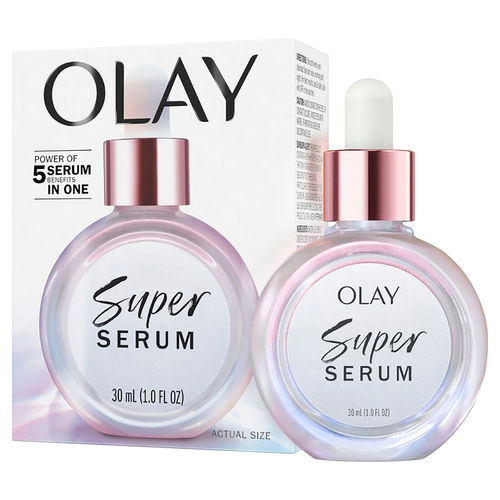
Olay Super Serum is a credible competitor rather than a token inexpensive product added to make the table look egalitarian. The specific 30ml formulation listed in Boots combines niacinamide, vitamin C, a collagen peptide, vitamin E and an alpha-hydroxy acid. Olay markets it for improved texture, more even-looking tone, firmer-feeling skin, smoother visible lines and hydration. Those are practically the same consumer concerns that bring people to Dermalogica E², although the formulations use different technologies.
At £39.99 upfront, it is easier to try without making a household budget meeting necessary. But its £13.33 per 10ml is much closer to E² than a glance at the two bottle prices suggests. It is a good example of a product that may address somebody's everyday goals with familiar, rational ingredients. It does not need the word 'regeneration' to explain why changes to the skin's surface and moisture content can improve appearance.
What we cannot say is that Olay and E² produce identical results. They have not been subjected to one properly controlled, matched comparative trial that would justify the claim. If somebody is principally concerned about texture and hydration, Olay deserves consideration. If they want the Dermalogica formulation and have used it successfully, the difference in normalised price is not as extreme as they might expect. It is about priorities, not brand tribalism.
No7 Protect & Perfect and Future Renew: similar ambitions, different products

No7 Protect & Perfect Intense Advanced Serum remains one of the more practical budget comparators. The identifiable UK 30ml listing has a £27.95 standard price, equivalent to £9.32 per 10ml. Good Housekeeping chose Protect & Perfect Intense Advanced as its Best Value in a 2026 laboratory-tested anti-ageing serum comparison. Such a result does not mean it has beaten every premium product under identical conditions, but it does demonstrate that the high street can produce a genuinely credible research-led choice.

No7 Future Renew Damage Reversal Serum is a different product and should be evaluated separately. The 50ml official reference size is £47.95, or £9.59 per 10ml. It is marketed for wrinkles, uneven skin tone, texture, visible dryness and skin that feels less elastic. No7 has publicised its peptide research and its testing of visible signs of skin damage. The phrase 'damage reversal' is visually dramatic; it should be read in relation to the specific measured outcomes, not as a claim that lost anatomy has simply been reconstructed.
There is a genuine point of difference here. No7 gives consumers familiar retail access, a comparatively manageable purchase price and a published research story. Dermalogica brings a different, exosome-and-enzyme-led formula, more volume and our direct experience with customer feedback. Which is preferable depends on the actual skin concern and tolerance. The industry often writes as though any product launched more recently must be a generational leap. Skin biology has yet to sign that agreement.
L'Oréal Paris Revitalift Laser Tripeptide: choosing the correct bottle matters

The L'Oréal Revitalift range contains enough variations to defeat a casual shopping search. We have deliberately chosen the specific UK Revitalift Laser Tripeptide Serum, 30ml, listed by Boots at £31.99. This version is marketed for wrinkles, uneven tone and lack of firmness and includes several peptides within its ingredient list. It is not an exosome product, but it addresses the same outward complaints.
Its £10.66 per 10ml represents a meaningful lower-cost comparison. At its normal shelf price, somebody can try the formulation for a fraction of Dermalogica's upfront cost. But that does not give us permission to claim it performs equally well, or that it is inferior because it is sold on the high street. Neither statement is supported by direct comparative evidence.
I am particularly wary of phrases such as 'Botox in a bottle' when peptide skincare is discussed. This is a cosmetic serum, not a prescription neuromodulator. The peptide formulation may improve visible lines by whatever mechanisms its finished-product evidence supports. It should not be described as reproducing an injected medicine's biological action.
Medik8 Liquid Peptides Advanced MP: the premium peptide route

Medik8 Liquid Peptides Advanced MP is a proper luxury-category alternative, using the company's multi-peptide and proprietary MiniProtein approach to the appearance of expression lines and wrinkles. The current official UK 30ml price is £82, or £27.33 per 10ml. That is substantially more expensive than E² when normalised for volume, notwithstanding the lower price at checkout.
Medik8 publishes early and longer-term product claims supported by comparatively small studies. These deserve the same scrutiny applied to Dermalogica's investigations: who participated, what was measured, whether there was a credible comparison and how meaningful the change was to users. An instrumental or photographic difference can be worthwhile without proving a new permanent structural alteration.
Medik8 is especially useful in this review because it competes for similar cosmetic outcomes using a different technological argument. If a reader wants to reduce the appearance of fine lines and find a premium product that fits their routine, it is a legitimate option. We have not personally conducted a head-to-head clinical evaluation of Medik8 and E². It would be misleading to suggest that being a Dermalogica partner gives us laboratory certainty about another manufacturer's bottle.
SkinCeuticals P-TIOX: luxury pricing under the microscope

SkinCeuticals P-TIOX is marketed as an advanced peptide serum for multiple visible wrinkle patterns and skin smoothness. The manufacturer lists the 30ml UK product at £135, making it £45 per 10ml. It is a serious premium formulation, but that figure matters. It costs approximately three times as much by volume as Dermalogica E².
The manufacturer's clinical claims are worth reading in the context of their actual endpoints rather than equating an improvement in wrinkle appearance with an injectable medical effect. People may choose SkinCeuticals for formulation, texture, skin suitability or professional recommendation. None of those reasons is inherently wrong. But paying substantially more per millilitre raises the reasonable question of whether the user expects sufficiently different results to justify the expense.
The most sophisticated product is not necessarily the one that costs the most. A customer who gets better tolerability or notices more improvement from a cheaper formulation has made the better purchase for themselves. Conversely, a premium product used happily and consistently can prove better value than an inexpensive serum which sits untouched after the first week.
A note on CeraVe, and why we haven't pretended every option is a serum

CeraVe Skin Renewing Peptide Night Cream is a moisturiser-led option aimed at hydration, barrier support and the appearance of ageing skin. At approximately £30 for 48g, it may be a sensible choice where dryness and the appearance of crepiness matter more than intensive surface renewal. Its emphasis on ceramides and moisturising support makes it a different proposition from E².
It has a place in the discussion because many people searching for 'firmer skin' are describing dryness and a lack of softness. A well-chosen cream may address that complaint more economically than an expensive multi-active treatment. But grams are not millilitres, and a night cream is not functionally identical to a leave-on renewal serum. Rather than force a misleading comparison, we can describe it as an adjacent lower-cost option.
What can we conclude from all seven? The market contains several credible formulas pursuing overlapping appearance goals. E² is unusually strong on volume-adjusted value within the premium group and has favourable practical feedback; No7 and L'Oréal win on lower initial cost; Olay has a compelling multi-benefit formula; Medik8 and SkinCeuticals provide different premium peptide strategies. There is no robust single comparative clinical dataset establishing an overall winner. Any review claiming one without qualification is choosing drama over evidence.
Can skincare be an alternative to prescription anti-wrinkle treatments?
There is a perfectly legitimate group of people who want smoother-looking skin and less conspicuous fine lines without needles. They are not obliged to have medical procedures, and there is often plenty we can discuss in terms of skincare, sun protection and appropriate professional skin-quality treatments. But it is essential to distinguish a non-injectable option for some concerns from a treatment that achieves the same biological effect as a prescription medicine.
Botulinum toxin is a prescription-only medicine affecting neuromuscular signalling. Its mechanism involves reducing selected muscle activity. A cosmetic serum does not work by the same mechanism. It can improve hydration and texture and, depending on the formulation, the appearance of certain fine lines. It does not therefore become a medical substitute for treatment of dynamic expression lines.
Consider the fine superficial line that stands out when skin is dehydrated. Hydration can make it noticeably less obvious. A line associated with photoageing may be a longer-term target for appropriately chosen topical actives. A deep movement-related crease that appears or deepens when a person frowns is an entirely different proposition. The same face may contain all three. It is not surprising that one bottle cannot promise identical results for them.
The phrase 'Botox alternative' is therefore a useful example of the difference between search language and clinically accurate language. People type it into Google because they want to avoid injections. We can answer that question honestly: yes, there are topical options for improving skin quality and the appearance of some lines, but no, those products have not been shown to reproduce the mechanism or all the effects of prescription neuromuscular treatment. The distinction protects readers from disappointment.
There is also a role for procedures directed at skin quality, such as appropriately selected microneedling or professional exfoliation, following individual assessment. But these should not be bundled into one interchangeable category with injectable medicines. The expected endpoint, contraindications, recovery and evidence differ. No one should be sold a procedure simply because they are unhappy with the number of products in their bathroom.
No.1 Urban Aesthetics offers assessment and professional skincare advice to help people choose a sensible routine and understand the available non-prescription skin-quality approaches. We do not use a consumer product article to advertise prescription-only medicines. Clinical decisions, where relevant, belong in an appropriate individual consultation rather than an affiliate shopping guide.
For many readers, that will be enough. They want their skin to look smoother, feel more comfortable and age with a little less visible evidence of accumulated weather and bad decisions. Skincare can be useful without pretending to put facial muscles on annual leave.
How I'd spend the money — and the verdict
It would be an easy ending to crown a winner. Beauty magazines like a winner, shopping algorithms like a winner and a page full of products is tidier when somebody is awarded a medal. Unfortunately, a human face is not a horse race.
If someone has never established a reliable routine, my first recommendation would not usually be an elaborate serum. Sensible cleansing, moisturising appropriate to the person's skin and consistent broad-spectrum sun protection create the foundations on which other products can be evaluated. There is very little point purchasing an advanced renewal treatment while ignoring the ultraviolet exposure that contributes substantially to visible photoageing.
If the dominant concern is rough texture, dullness and superficial fine lines, E² is an interesting option, as are suitable exfoliating and peptide formulations. If dehydration and barrier discomfort are the principal complaints, an affordable moisturising product may achieve much of the desired change. Where photodamage-related wrinkles are a significant issue, established evidence for certain retinoids warrants consideration with an understanding of their precautions and tolerability.
A person's budget is not a superficial concern. Spending £148 on a bottle of skincare is a meaningful purchase. Yet a product that lasts four months, gets used consistently and delivers a change the customer notices can be better value than a succession of neglected cheaper products. Conversely, the expensive option is poor value if it irritates the skin, does not fit the routine or is bought in the expectation of dramatic structural change.
From our own experience, the customer reception to Phyto Nature E² has been unusually favourable. People describe improved skin texture, less visible fine lines and skin that feels tighter. They also report around four months of daily use from a 100ml bottle. That is authentic customer feedback, not the result of a blinded comparative trial, and it should be read in that spirit.
The independent tests and coverage give that feedback context. Dermalogica's small product study reports favourable results; Good Housekeeping measured improvements in brightness, colour spots and texture in its testing; woman&home made E² an award-winning exfoliating treatment; and YOU Magazine's writer observed visible improvement. Each is a different type of evidence. Together they make E² a credible, noteworthy premium product. They do not prove that the exosome component alone causes all the improvement or that the serum is scientifically best in class.
I would happily regard E² as a serious option for the right customer. I would be equally willing to suggest an Olay, No7 or L'Oréal alternative where the person's skin, budget and expectations make that the more sensible starting point. Our Dermalogica partnership provides genuine professional familiarity with the product; it should not require us to pretend the competition doesn't exist.
The verdict, then, is that anti-ageing serums really can improve visible aspects of skin quality. They do not all achieve the same thing and cannot eliminate every sign of ageing. Phyto Nature E² stands out for its thoughtful combination of surface-renewal ingredients, encouraging product testing, positive customer experience and surprisingly competitive per-ml price among premium brands. It is worth considering, not worshipping.
A useful serum has no obligation to perform miracles. It has the much harder job of making a discernible difference to ordinary skin under ordinary bathroom lighting, with no glamorous laboratory standing just outside the door.
How to buy, and where our price match fits
No.1 Urban Aesthetics is a professional Dermalogica partner. Dermalogica Phyto Nature E², 100ml, has a UK listed reference price of £148. Readers in or around Newcastle-under-Lyme can enquire about buying in clinic at 56 Ironmarket and our eligible Dermalogica price-match offer, subject to product and retailer verification and our normal terms. We can also discuss its place in an individual skincare routine.
Buy Dermalogica Phyto Nature E² 100ml on Amazon UK. This uses the exact product ASIN supplied for the review and our Amazon Associates tracking ID. Please check the live listing's pack size, seller, stock and price before purchasing. As an Amazon Associate, we earn from qualifying purchases.
The other products in the comparison will receive direct Amazon UK affiliate product links only where the exact UK formulation, pack size and individual ASIN can be verified. We will not substitute a generic search page for a precise product page or invent a seller. Retailer/manufacturer links in the evidence section allow readers to identify the products while those affiliate listings are confirmed.
Frequently asked questions
What is the best anti-ageing serum for fine lines and wrinkles?
There is no universally proven winner. A hydrating serum may make dehydration lines less noticeable; appropriately formulated retinoid products have stronger established evidence for certain photoageing outcomes; exfoliating and peptide products can improve specific aspects of texture and appearance. The right choice depends on the cause of the lines, tolerance and budget rather than ranking every formula on a single imaginary scale.
Can skincare really tighten the skin on your face?
Some products can make skin look and feel firmer, and our customers describe that sensation with Phyto Nature E². It does not automatically mean the product has lifted tissue or rebuilt underlying facial structures. Hydration, surface smoothness and the way a formula feels on the skin may all contribute to the perceived change. The appropriate description is firmer-feeling skin unless objective structural results have been established.
Is Dermalogica Phyto Nature E² a PDRN product?
No. It is a topical exosome-and-enzyme-led leave-on formula. PDRN is a different DNA-derived ingredient, and injectable polynucleotides are another distinct treatment category. Similar marketing language about skin quality does not make the materials or delivery methods equivalent.
Does the 86% regeneration claim mean skin is 86% younger?
No. Dermalogica's published 86% figure relates to an in-vitro laboratory endpoint against untreated skin. It is not a measurement of biological age reversal in people, nor a clinical finding that wrinkles have reduced by 86%. Its clinical data on visible signs of ageing is separate and based on a small study involving 32 participants.
How long does a bottle of E² last?
Several customers at our clinic report approximately four months of daily use from the 100ml bottle. Your actual duration will depend on quantity, frequency and area of application. At £148 and 120 days, that is approximately £1.23 a day, but this is a practical estimate based on customer reports, not a guaranteed number of applications.
Is a £148 serum worth it compared with a £30 one?
It can be, but not automatically. E²'s 100ml bottle costs £14.80 per 10ml, compared with £10.66 for the identified L'Oréal Revitalift Laser Tripeptide serum and £9.32 for No7 Protect & Perfect Intense Advanced. Olay Super Serum costs £13.33 per 10ml at its listed £39.99 price. These comparisons tell us about quantity and price, not proven superiority. You should also consider actual results and tolerability.
Is E² suitable for sensitive skin?
Individual tolerance varies. The published ingredient list includes exfoliating lactic acid, aromatic botanical oils and fragrance allergens such as limonene, linalool and citral. People with known fragrance allergies, an impaired barrier or very reactive skin should consider suitability carefully and avoid combining multiple strong active products indiscriminately. Persistent irritation is a reason to stop using it and seek appropriate advice.
Can I use E² alongside a retinoid or an exfoliating treatment?
Possibly, but the combined routine should be assessed, particularly if the person is prone to irritation. Dermalogica E² already contains renewal and exfoliating ingredients. Timing around professional peels, microneedling and other procedures should follow specific clinician aftercare advice. A more intensive routine is not automatically a more effective one.
Can an anti-ageing serum replace anti-wrinkle injections?
Not as an equivalent medical treatment. Cosmetic serums can improve some visible lines, hydration and texture. Prescription botulinum toxin works through a different neuromuscular mechanism and is subject to medical assessment and regulation. Someone who wishes to avoid injections can still benefit from suitable topical skincare, but they should not expect identical effects on dynamic expression lines.
When should I expect to notice results?
Immediate moisturising or surface effects may be noticed quickly. Dermalogica reports improvement in visible signs of ageing from two weeks in its product study. More durable changes with other active ingredients may take considerably longer. There is no single timescale applying to all serums or all types of fine lines.
Do exosome serums penetrate skin and rebuild collagen?
The literature is investigating how different extracellular vesicle formulations interact with skin and whether they can influence cellular pathways. Current human research remains limited, and findings from assisted delivery or experimental preparations cannot be assumed to apply to a daily leave-on consumer product. Claims about rebuilding collagen should be supported by direct evidence for the actual finished formula and endpoint.
Would you choose Dermalogica or a high-street brand?
That depends on the person. E² has favourable customer feedback in our clinic and a sensible value argument when bottle size is considered. A high-street product may be a better initial choice for somebody prioritising affordability, gentle hydration or a more limited routine. We do not have a comprehensive head-to-head clinical trial establishing one serum as the best choice for all ages and skin types.
Further reading: published research, independent testing and manufacturer evidence
These are the source materials underpinning the discussion. A manufacturer's claim, a peer-reviewed review of experimental therapy and a beauty editor's practical test are different types of evidence. They are grouped accordingly so readers can examine them for themselves.
Product specifications and claims
Dermalogica UK: Phyto Nature E², formulation, instructions and clinical footnotes. Official source for the product, 100ml pack, £148 price, ingredients and manufacturer claims.
Olay Super Serum 30ml — Boots UK. The specific multi-benefit formula and UK reference price.
No7 Protect & Perfect Intense Advanced Serum 30ml — Boots UK. UK product reference and standard price.
No7 Future Renew Damage Reversal Serum 50ml — No7 UK. Official size and recommended price.
L'Oréal Paris Revitalift Laser Tripeptide Serum 30ml — Boots UK. Exact UK product variant and ingredients.
Medik8 Liquid Peptides Advanced MP — Medik8 UK. Product identity, UK price and manufacturer study claims.
SkinCeuticals P-TIOX — SkinCeuticals UK. Official 30ml price and intended outcomes.
CeraVe Skin Renewing Peptide Night Cream 48g — Boots UK. A moisturiser-led alternative, measured by weight rather than volume.
Peer-reviewed research
Knauer and colleagues, 2026: Clinical Evidence and Commercial Landscape of Topical Exosomes for Skin Rejuvenation. A scoping review highlighting limited human studies, variable exosome sources and differences in delivery method.
Burshtein and colleagues, 2026: Plant-Derived Extracellular Vesicles in Dermatology. Review of plant-derived technology with substantial limitations in human clinical evidence.
Gaebe and colleagues, 2026: Extracellular Vesicle-Based Therapies for Nonsurgical Facial Rejuvenation. Systematic review reporting preliminary findings but low or very low certainty for many outcomes.
Stack and colleagues, 2026: Clinical Advances in Exosome-Based Therapies for Aesthetic Medicine. Broad meta-analysis of heterogeneous interventions; not a finished-product trial of E².
Siddiqui and colleagues, 2024: Comparing Tretinoin to Other Topical Therapies in the Treatment of Skin Photoaging. Context for established retinoid evidence, comparative study limitations and tolerability.
Tretinoin for Photodamaged Facial Skin: systematic review and meta-analysis of randomised trials. Clinical evidence relating to topical tretinoin, distinct from exosome cosmetics.
Popular magazines and independent assessments
Good Housekeeping, September 2026: Anti-ageing serums tested by beauty scientists and consumers. Includes Dermalogica E² for brightening and No7 Protect & Perfect for value, alongside the testing approach.
woman&home, June 2026: 2026 Skin Awards winners. Names Phyto Nature E² Best Exfoliating Treatment.
Daily Mail / YOU Magazine, April 2026: five aesthetic technologies and treatments. Includes Phyto Nature E² as its topical exosome skincare pick and reports a favourable experience.
Interested in other Dermalogica products?
If you want to explore the wider range, browse Dermalogica-related Amazon UK search results through our affiliate link. This is a search page, not a verified official Dermalogica storefront, so always check the individual product, seller and pack size. A qualifying Amazon purchase after following our affiliate link may earn commission for No.1 Urban Aesthetics.
Alternatively, visit or contact No.1 Urban Aesthetics, 56 Ironmarket, Newcastle-under-Lyme, for professional product advice and eligible Dermalogica price matching. The aim is to choose something appropriate for the skin you actually have, not acquire the largest possible number of bottles.
Clinical and editorial note: Written by Rebecca Beckett, RN and Director of No.1 Urban Aesthetics. Reviewed October 2026. The article is educational and is not a substitute for personalised medical assessment. We are Dermalogica partners, and Amazon affiliate links may generate commission. Product availability and prices can change; clinical claims are attributed to their sources and customer feedback is described as informal experience.
Ad — The following link is an Amazon affiliate link (paid link). As an Amazon Associate I earn from qualifying purchases.